Pages

Sunday, 16 June 2019

Insam Cha 인삼차 (Korean Ginseng Tea)

My in law came to visit not long ago and brought us some fresh ginseng.  These are 6 year old ginseng.  Do you know how to recognize the age of ginseng?  My mother in law taught me by counting the "head" of the ginseng, the top part of ginseng... I think it's a great tip :) Have a try the next time you go shopping for ginseng~
Since we can't consume all the ginseng in one go, we wash and clean up the fresh ginseng and keep them in freezer.  By keeping the fresh ginseng in freezer, it will help to last longer up to 2 - 3 months.  We usually cook Samgyetang (ginseng chicken soup) but since there are a roots falling apart when we did the washing and cleaning.  We collected them and boil ginseng tea.  Nothing goes to waste ^^


Yield: About 2 liter of ginseng tea
Ingredients:
A handful of Ginseng roots or 1 Ginseng
25 piece Red dates (jujube)
10 piece Dried longan (optional)
3 liter Water

Step by step photos:


  1. Wash and clean up the ginseng and red dates.  Prepare a pot, put in the ginseng, jujube, dried longan and water.  Boil over medium high heat for 30 minutes.
  2. After 30 minutes, close the lid and simmer over low heat for another one and half hour or until you get brownish red color of tea. 
  3. Off the fire and serve.
  4. To get the full amount of flavour from the ginseng, add more water and boil it over for the second time.  Keep the tea in the fridge and drink it anytime.  If you like your tea hot, reheat and serve.
**My mother in law told us that it's best to cut off the head of the ginseng when you consume them as it's believed that the head part provides too much heat to the body if consume.

Tuesday, 16 August 2016

Chicken Breast Salad with Danmuji (Korean radish pickle)

I saw this recipe in one of the Korean cooking TV programme - Homefood Rescue 2.  They added danmuji in the salad which makes me wonder how would it taste and I am so eager to try it out as there are still some danmuji sit in my fridge after my last made gimbap ^^

This recipe is definitely a keeper as I love the texture of the salad.  The danmuji suits really well in the salad!  The sourish, sweet and tangy taste from danmuji compliments the salad and the crunhy texture of it makes you munch on the salad non-stop...lol ;)  Hope you all will like it as much as I do~


Serving: 2 person
Ingredients:
1 whole piece of Chicken Breast Meat
1 Japanese Cucumber (medium size)
1/4 cup chopped Carrot
1/4 cup chopped Onion
1/4 cup chopped Danmuji (Korean radish pickle)
2 hard boiled Egg (Optional)
1 tsp Salt
1 tbsp Vinegar
1/2 Lemon
Pinch of Black Pepper and Salt (To taste)

Step by step photos:


  1. Wash and cut cucumber into quarter and slice thinly.  Place the cucumber in a bowl and add 1 tsp of salt.  Slightly mix the cucumber with salt to marinate.  Set aside for 20 minutes.
  2. Prepare a small pot, add in water and bring it to boil.  Add in the chicken breast meat and boil for 10 - 15 minutes or until it is cooked.
  3. Take out the chicken breast meat once it's cooked and set aside to cool down.
  4. Drain the cucumber water (Try to taste the cucumber, if it's too salty, try to wash with some water and drain again).
  5. After drain the cucumber, squeeze out excessive water from the cucumber with hands (this step will help to get crunchy cucumber :).
  6. Mix all the veggies (carrot, cucumber, onion and danmuji) in a big bowl.
  7. Add in 1 tbsp of vinegar and toss to mix well.
  8. After the meat has cool down, tear it into thin strips, and add in the salad bowl.  Add in the hard boiled egg too if you have.
  9. Sprinkle some salt and pepper to taste.  Toss to mix well.
  10. Squeeze some lemon juice into the salad.  Toss and ENJOY your salad!
Tip:
Add some mayonaise and it will serve as a great yummy filing to sandwich! ^^


Thursday, 4 August 2016

Bibim Guksu 비빔국수 (Korean Spicy Mixed Cold Noodle)

The weather is quite hot recently.... hubby and I do not have much appetide so I decided to make this simple spicy and sourish mixed cold noodle today :)

Bibim guksu is quite a fast dish to prepare, the ingredients are simple and it's full of green leaves too which is a healthy choice! Usually the type of veggie used in this dish is cucumber but I have a bunch of salad leaves in my fridge so I use salad leaves. Any veggie leaves that gives a crunch texture will goes well with this noodle. ^^


Serving: 2 person
Ingredients:
About 180g of Thin noodle (somyeon or 寿面)
A quarter of medium size Cucumber (sliced thinly)
A bunch of crunchy salad leaves (slightly slice/tear into smaller pieces)
Some sliced carrot (Optional)
1/2 cup of chopped kimchi
1 hard boiled Egg

Sauce:
2 & 1/2 tbsp Gochujang (Korean hot pepper paste)
1 tsp Gochugaru (Korean hot pepper flakes)
1/2 tbsp finely minced Garlic
15 tbsp Kimchi juice
1 tbsp Soy sauce
1 tbsp Vinegar
1 tbsp Sesame oil
1 tsp Sugar (or 1 tbsp Honey)
1 tsp Roasted black/white Sesame seeds

Step by step photos:


  1. Wash and drain the veggies, set a side or keep in fridge for extra cool and freshness.
  2. Prepare the sauce by mixing all the sauce ingredients, gochujang, gochugaru, minced garlic, kimchi juice, soy sauce, vinegar, sugar, sesame oil and sesame seeds).  Keep it cool in fridge.
  3. Boil a pot of water.  When the water starts to boil, add in noodle and boil for about 5 to 6 minutes or until the noodle becomes cook. 
  4. Prepare a big bowl of icy water to cool down the noodle.
  5. Off the heat and drain the noodle quickly under running cold water.
  6. Place the drained noodle into the bowl of icy water to get chewy and cold noodle.
  7. Prepare a bowl, drain the cold noodle by slightly press the noodle with hand after lift up from the icy water.  *I add in a few ice cubes in the bowl because i like my noodle COLD...hehe ;p
  8. Place the veggies and hard boil egg on top of the noodle.  Add the sauce, mix and yumm!
*Tip:
- You can use soba (buckwheat noodle) for this dish too.


Wednesday, 22 June 2016

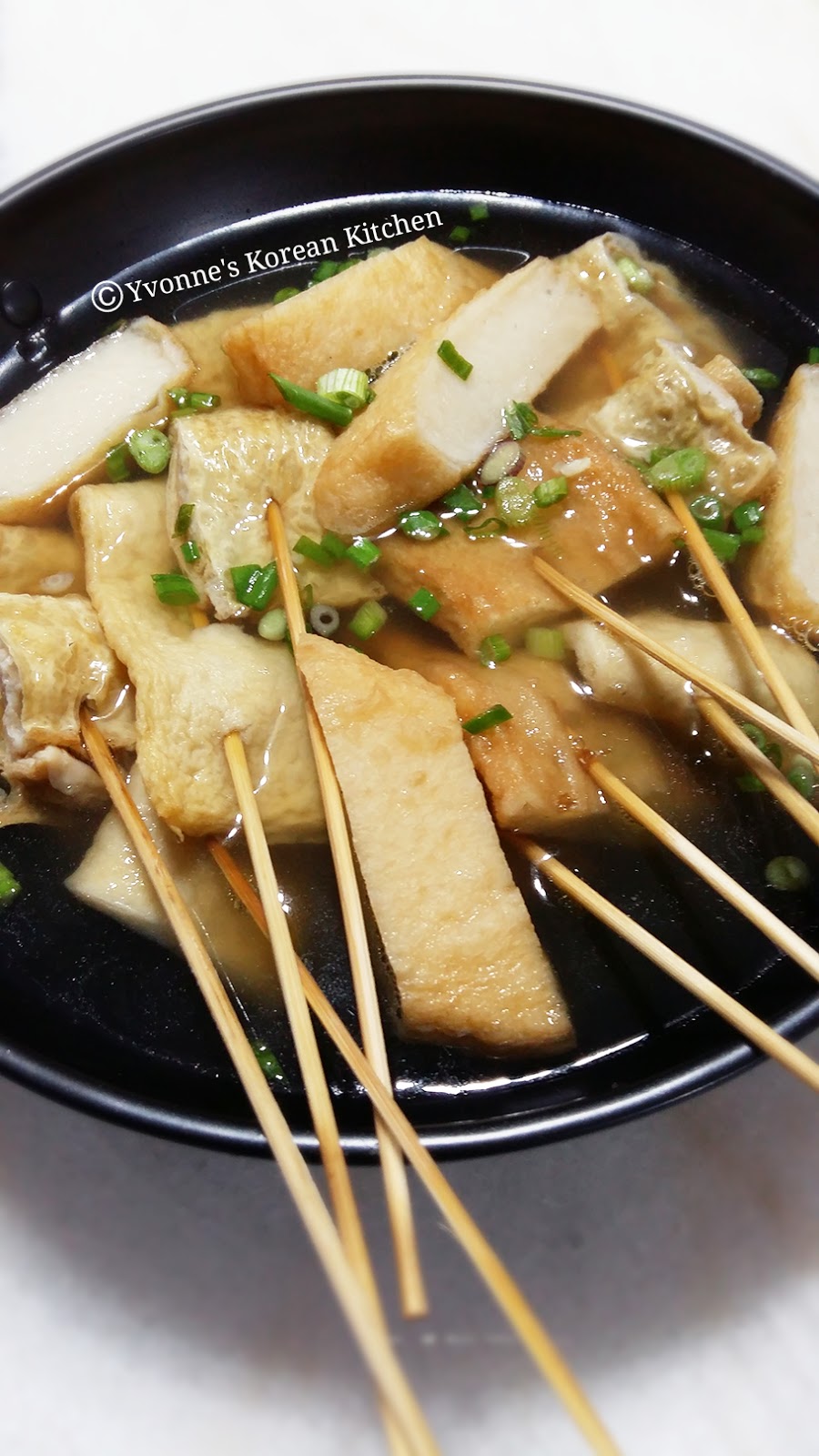
Eomuk Guk/Odeng Guk (Fish Cake Soup)

Recently the weather here is rather a bit cold due to the raining and we have been craving for some hot soups. Eomuk guk pop up in my head, I like to drink this soup when we visit Korea, walking along the streets, you will see many street food vendors selling this especially during cold weather in winter.  They serve the soup in a paper cup which is very convenience and also the soup not only warms my tummy but also help to warm up my hands by holding the cup...lol ;)

You can use any types of fish cake, in Malaysia we can find a lot of different type/shape of fish cakes.  you can add in crab meat stick or squid balls too.  It's a bit like our steamboat or lok-lok here but with a different broth :)


Ingredients:
350g of assorted Fish Cakes
8-10 piece wooden Skewers
Some chopped Spring onion

Broth:
1.8liter of Water
6 Kelp (6cm x 5cm)
25 piece of  Anchovies
300g Radish (cut into slices)
1 stalk of Leek (use only white part)
1/4 medium size Onion
2 tsp Soy sauce
1 tsp Salt

Dipping sauce A: (Optional)
2 tbsp Soy sauce
2 tbsp Water
1/2 tsp Garlic (finely minced)
1/2 tsp Sesame oil
1/2 tsp Sesame seeds (optional)
1/2 tsp Gochugaru (Korean hot pepper flakes)
Some Green/Red sliced chillies
Some Chopped Spring onion

Dipping sauce B: (Optional)
2 tbsp of Tsuyu (Japanese soup stock)
Some Wasabi

Step by step photos:


  1. Prepare a pot (Use a pot that is high/deep enough for the skewers to submerge in the broth), add in water, kelp and anchovies.  Boil over high heat for 20 minutes without lid.
  2. Remove the kelp and anchovies.
  3. Add in leek, onion and radish.  Keep boiling over medium low heat for 30 to 40 minutes with lid closed.
  4. While the broth is boiling, make fish cake skewers.
  5. After 30 to 40 minutes of boiling, remove the veggies (radish, onion and leek) to get clear broth.
  6. Season broth with soy sauce and salt.
  7. Add in fish cake skewers and boil for 10 to 15 minutes until cook.
  8. Add some chopped spring onion and serve hot~
Tip:
- Taste the saltiness of the soup broth after add in fish cakes and adjust from there.  Because the fish cakes add some saltiness to the soup.
- If you plan to have the fish cakes by dipping in the sauce, do not add too much soy sauce/salt in the broth.

Wednesday, 15 June 2016

Yukgaejang (Spicy Meat and Vegetable Stew) 육개장

Yukgaejang, a nutritious stew made from various types of vegetables.  Usually beef is used to make this stew but I substitute with pork today as I do not eat beef... You can use chicken to make the stew too, it taste equally yumm! :)
 
It's actually require quite a lot of work and time in making yukgaejang from soaking the dried veggie, pulling the meat into strips and boiling the stew for hours....but, the delicious taste from the stew is really worth the effort.  I made a big pot of yukgaejang today and plan to freeze some for later since the hardwork of making this, why not make a lot and freeze for later, right? hehehe lazy me! ;)  Yukgaejang can be consumed for a few days if keep in the fridge or longer up to weeks if kept in freezer.  It's said that the Korean mum will cook this stew if they have plan to go away for a few days of short trip, yukgaejang will keep the husband and children's tummies full.. May be I shall plan a short vacation with my bff and prepare this stew and keep in the fridge for my husband *wink*
 
Some yukgaejang recipes is using one kind of dried vegetable which is gosari (fernbrake), But, my husband insist that To-ran (taro stem) is a must in making the soup =.=", and....I actually have to agree with him.  By adding taro stem, I feel that it helps to balance the smell of gosari which become less strong and the stew taste really balance with the meat, veggies and hint of spiciness.  It may be hard to find these dried vegetables in some area but if can, try to get both To-ran (taro stem) and Gosari (fernbrake) in making this stew.


Ingredients:
1kg of Pork
2 cup of Gosari (fernbrake) (After soaked, squeezed and cut)
1 cup of To-ran 토란 (Taro stem)  (After soaked, squeezed and cut)
1 cup of Shiregi 시레기 (Dried radish greens) [After soaked, squeezed and cut) *Optional
10 piece of Dried Shiitake Mushrooms
1.5 cup of Bean Sprouts
3 stalk of Leek
1 Onion (Large size)
4 liter of Water
 
Seasoning/Sauce:
5 tbsp Soy sauce
4 tbsp Gochugaru (korean hot pepper flakes)
5 tbsp Minced Garlic
2 tbsp Sesame Oil
2 tsp Salt (or more according to taste)
1 tsp of Black pepper
 
Step by step photos:
 

To-ran 토란 (Taro Stem)


  1. Boil dried gosari, to-ran and shiregi for 2 to 3 hours separately in water over medium high heat until they are soft.  (Or you can skip this step by soaking them overnight until they turn soft).
  2. Drain the boiling water.  Wash them with cold water and squeeze out excess water.  Cut into about 8cm length.  Set aside.
  3. Prepare a big pot, add in water and boil over high heat.
  4. Once the water is boiled, turn to medium high heat and add in meat and dried shiitake mushroom.  Boil for about 40 minutes.
  5. While waiting, slice the leek and onion.  Prepare the seasoning sauce by mixing soy sauce, gochugaru, minced garlic, sesame oil and back pepper.
  6. Prepare a big bowl, put in the sliced leek, onion, bean sprout, gosari, to-ran and shiregi.  Add the seasoning sauce and mix with hand until well combined. Set aside.
  7. After 40 minutes, scoop out the meat and mushroom, put aside to cool down.
  8. Add the seasoned vegetables in step 6 to the boiling meat stock and boil for 20 minutes.
  9. Once the meat and mushroom are cool down, slice the mushroom and tear the meat into strips by hand.
  10. Add the sliced mushroom and meat strips back into the boiling stock and cook over medium low heat for another 1 hour with lid closed.
  11. Serve with warm rice~
 
Tip:
- This stew usually use beef, but pork and chicken taste good too.
- If time allows, prepare the stew in the morning/afternoon and serve for dinner.  Let the stew cool down and re-boil again for another 30 minutes before serve.  This step makes the stew taste so much richer.